There are few places on Earth where the elements feel as alive as they do in Iceland. This is a land where the air is sharp and clear, the ground still warm from ancient lava, and the horizon seems to shimmer between worlds of fire and ice. Across the island, glaciers crown volcanic peaks and spill into valleys, their slow movement shaping rivers, cliffs, and coastlines. They are not just part of the landscape, they are the landscape, carving Iceland’s character with every passing century. In this post, you’ll learn all about Iceland’s glaciers. Join us for this memorable tour!
Introducing the amazing Icelandic glaciers
For many visitors, the first sight of a glacier is a moment they never forget. The scale is humbling: endless white stretching toward the sky, streaked with blue and black where volcanic ash has become part of the ice. There is silence, broken only by the creak and crack of movement beneath the surface, the sound of the earth still forming itself.
Glaciers are storytellers of time. Each layer of snow preserves a season, a storm, a year. Buried deep inside are traces of volcanic eruptions, ancient winds, and shifts in climate that reach back thousands of years. Walking on a glacier is like stepping into Iceland’s memory, a glimpse of how the island has evolved and endured.
And while their power is immense, their presence is also fleeting. These rivers of ice have been retreating for decades, changing with the warming climate. To stand before them today is to feel both awe and awareness: the wonder of seeing something vast and eternal, and the quiet knowledge that it, too, is changing.
What Makes a Glacier
A glacier isn’t just frozen snow, but it’s a living, moving mass of ice. Over centuries, layer upon layer of snow compacts under its own weight until it transforms into dense, blue-tinted ice. Slowly, almost imperceptibly, that ice begins to flow, like a river moving in slow motion.
As glaciers move, they sculpt the land beneath them, carving deep valleys and leaving behind ridges, moraines, and glacial lagoons. Every crack and ripple tells a story about pressure, temperature, and time. The brilliant shades of blue you see inside the ice come from that immense compression, all the air squeezed out, letting only blue light pass through.
In a sense, standing on a glacier is like standing on time itself: the snow beneath your boots may have fallen before the first human set foot in Iceland… Isn’t that fascinating?
Iceland, the Land of Glaciers
Around 10% of Iceland is covered in ice, spread across roughly 269 named glaciers. Most lie in the island’s central and southern regions, where heavy snowfall and cold temperatures allow the ice to thrive. Yet their presence is felt everywhere, since they feed rivers, shape valleys, and even influence Iceland’s weather patterns.
Because Iceland sits atop one of the world’s most active volcanic zones, the interaction between heat and ice is constant. Beneath the thick sheets of ice, volcanoes rumble quietly, and sometimes violently. When a subglacial eruption occurs, the sudden meltwater can cause powerful floods known as jökulhlaups, racing across the plains and reshaping the landscape in hours.
It’s this combination of volcanic fire and glacial ice that makes Iceland truly unique, a land defined by opposites that somehow coexist.
There are fascinating tours that will guide you on your journey to discover all this richness. Activities included in glacier tours typically include glacier trekking, ice climbing, and ice cave tours.
Below you have information about the main Iceland’s glaciers… Pay attention and prepare for your glacial adventure!
The Great Glaciers of Iceland
Vatnajökull — The Ice Kingdom
The crown jewel of Iceland’s glaciers, Vatnajökull covers more than 8,000 square kilometres, making it the largest glacier in Europe. It stretches across much of southeast Iceland, blanketing volcanoes, highlands, and valleys beneath hundreds of metres of ice.
Vatnajökull is so vast that it creates its own weather system. Beneath its surface lie several active volcanoes, including Grímsvötn and Bárðarbunga, whose eruptions can melt enormous volumes of ice in moments.
At its edges, long glacial tongues flow down toward the lowlands, creating some of Iceland’s most photographed landscapes: Skaftafellsjökull, Svinafellsjökull, and Falljökull, to name a few. Visitors to the South Coast often meet Vatnajökull through its lagoons, especially the spectacular Jökulsárlón Glacier Lagoon, where icebergs drift serenely toward the sea, and the nearby Diamond Beach, where pieces of crystal-clear ice sparkle against the black sand.
Vatnajökull is part of a vast national park, now a UNESCO World Heritage Site. Walking on its ice, you can feel the hum of the earth below, one of those moments when Iceland’s raw power becomes very real.
Langjökull — The Glacier Within Reach
Only a few hours from Reykjavík lies Langjökull, Iceland’s second-largest glacier. Its name means “Long Glacier,” and true to form, it stretches over 900 square kilometres across Iceland’s highlands.
Langjökull is a favourite for adventure seekers. Snowmobile tours here are especially popular, offering the thrill of gliding over the ice with endless white horizons around you. It’s also home to a man-made ice tunnel, one of Iceland’s most fascinating creations, carved deep into the glacier so visitors can walk through its glowing blue corridors and witness the layers of ancient ice up close.
Because of its location, Langjökull is a very accessible glacier, perfect for travellers who want a taste of the ice without heading too far east.
Mýrdalsjökull and Sólheimajökull — Fire Beneath the Ice
Further south rises Mýrdalsjökull, a mighty glacier that hides one of Iceland’s most dangerous volcanoes, Katla, beneath its thick ice cap. Though Katla has been quiet for over a century, scientists keep a close watch, since history shows that when it erupts, it can send floods rushing toward the coast within hours.
One of Mýrdalsjökull’s outlet glaciers, Sólheimajökull, is among the most accessible in Iceland and a highlight for many EastWest travellers on the South Coast tour. Just a short drive from the Ring Road, it’s a place where you can lace up your crampons, follow a certified glacier guide, and step directly onto the ice.
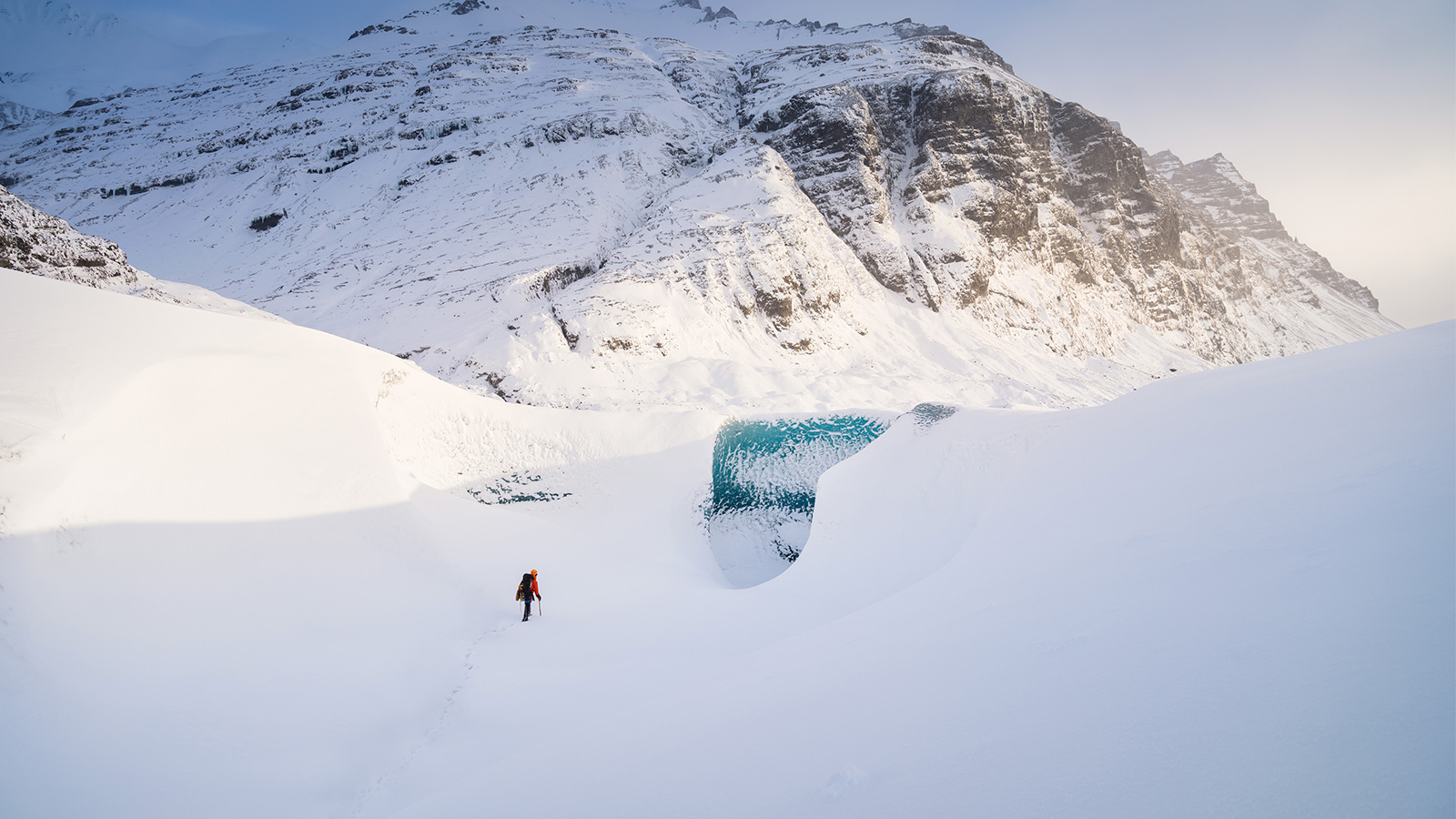
Here, black volcanic ash mixes with blue and white ice, creating a stunning marbled surface. In winter, ice caves sometimes form within the glacier, shimmering caverns that feel like something from another world.
Eyjafjallajökull — The Glacier That Stopped the World
Few people outside Iceland had heard of Eyjafjallajökull until 2010, when its eruption sent ash clouds sweeping across Europe and grounded thousands of flights. Beneath the headlines, however, lies a beautiful glacier in its own right.
Smaller and more modest than its neighbours, Eyjafjallajökull sits close to some of Iceland’s most visited spots, the waterfalls Seljalandsfoss and Skógafoss, for example, both lie in its shadow. On clear days, you can see the glacier’s white slopes from the Ring Road, a reminder that Iceland’s calm beauty is always balanced with the potential for drama.
Hofsjökull and Drangajökull — The Quiet Giants
Hofsjökull, in central Iceland, is both a glacier and a volcano. It’s the third largest glacier in the country and the source of several major rivers, including the Þjórsá, the longest in Iceland. Because of its remote location, Hofsjökull is less visited, but its isolation adds to its sense of mystery.
Far to the northwest, in the Westfjords, lies Drangajökull, the only major glacier in Iceland not shrinking as rapidly as the others. It’s also the northernmost glacier in the country, surrounded by a wild landscape of fjords and cliffs. Though smaller, Drangajökull offers a glimpse of Iceland as it once was: untouched, silent, and immense.
Experiencing Iceland’s Glaciers
One of the most remarkable things about Iceland is how accessible its glaciers are. Whether you’re looking for gentle exploration or a true adventure, there’s an experience for everyone.
Glacier Hiking
Walking on a glacier is a humbling experience. With a trained guide, you can safely navigate the ice using crampons and ropes, exploring crevasses, ridges, and the surreal textures of compacted snow and ash. Popular hikes include Sólheimajökull, Falljökull, and Svinafellsjökull, each offering a different perspective of the South Coast’s ice.
Ice Cave Tours
Every winter, as meltwater tunnels refreeze, natural ice caves form beneath the glaciers. These shimmering caverns glow with deep blue light, constantly shifting in shape and form. No two seasons ever look the same. Visiting an ice cave inside Vatnajökull or Mýrdalsjökull feels like stepping inside the heart of the glacier itself.
The ideal season to visit natural ice caves is winter, especially from November to March, as the ice is more compact. However, the cave on the Mýrdalsjökull glacier (Katla Cave) is accessible year-round.
It is important to remember that, for safety reasons, it is mandatory to book tours with experienced guides and use safety equipment.
Snowmobiling and Super Jeep Adventures
For those seeking speed and excitement, snowmobiling on Langjökull or Vatnajökull offers a thrilling way to experience the scale of the ice. With expert guides and all equipment provided, you can race across the glacier’s open expanse surrounded by endless snowfields and mountain views.
Glacial Lagoons and Boat Rides
At the edge of Vatnajökull, the Jökulsárlón Glacier Lagoon is one of Iceland’s most magical places. Here, icebergs that have broken off the glacier float silently across the turquoise water before drifting out to sea. Visitors can join boat tours among the icebergs, watching seals rest on their icy platforms.
Glaciers in Peril
As awe-inspiring as they are, Iceland’s glaciers are also fragile. Over the last few decades, scientists have observed a steady retreat across nearly all of them. Rising temperatures and changing precipitation patterns have caused glaciers to lose mass faster than at any time in recorded history.
One of the most symbolic examples is Okjökull, once a glacier in west Iceland. By 2014, it had melted so extensively that scientists officially declared it “dead ice”. A memorial plaque now stands there, addressed “to the future,” reminding us of what’s at stake.
If the current rate of melting continues, some of Iceland’s smaller glaciers could disappear entirely within the next century. The consequences go beyond scenery: glaciers feed rivers, influence ecosystems, and provide water for hydropower. Their loss will reshape Iceland’s environment in ways still hard to predict.
For travellers, this adds a bittersweet urgency: seeing the glaciers today means witnessing something that may not look the same for generations to come.
Glaciers as Stories of Iceland
More than frozen landscapes, glaciers are part of Iceland’s identity. They appear in sagas, songs, and folklore (sometimes feared, often revered). They remind Icelanders of both nature’s strength and its fragility.
For visitors, glaciers offer a moment of connection. Whether you’re standing at Jökulsárlón watching icebergs drift out to sea or feeling the crunch of crampons under your feet on Sólheimajökull, you’re part of a story that began thousands of years ago.
At EastWest, we see these glaciers every week on our South Coast tours, and they never fail to amaze. The light changes, the ice moves, and every visit feels different. That’s what makes them so special: they’re not frozen in time. They’re alive.
Seeing Iceland’s Wild Side
If you’re fascinated by Iceland’s glaciers, chances are you’ll love its other wild wonders too: from the cliffs where puffins nest in summer to the vast volcanic fields that stretch across the highlands. Together, they tell the story of a land still in the making.
You can read more about the National Parks of Iceland or explore the country’s protected areas in Iceland’s Nature Reserves.
And if you’re ready to experience these incredible places yourself, join one of EastWest’s small-group tours from Reykjavík — where every journey brings you closer to Iceland’s living landscape.