Few places in Iceland hold as much meaning, beauty, and quiet power as Thingvellir National Park.
Recognised as a UNESCO World Heritage Site, this is where Iceland’s story began, a place where dramatic landscapes meet the roots of its democracy, and where the country’s natural and cultural heritage intertwine in perfect harmony.
It’s one of the natural parks of Iceland that you can’t miss during your trip… Reading this post will help you understand why!
Where Two Continents Meet
Nowhere else on Earth can you walk between two continents as clearly as here. Thingvellir lies directly on the rift between the North American and Eurasian tectonic plates, which slowly drift apart by a few centimetres every year. The ground itself tells the story of our planet in motion, with deep cracks, cliffs, and valleys marking where the Earth is literally splitting in two.
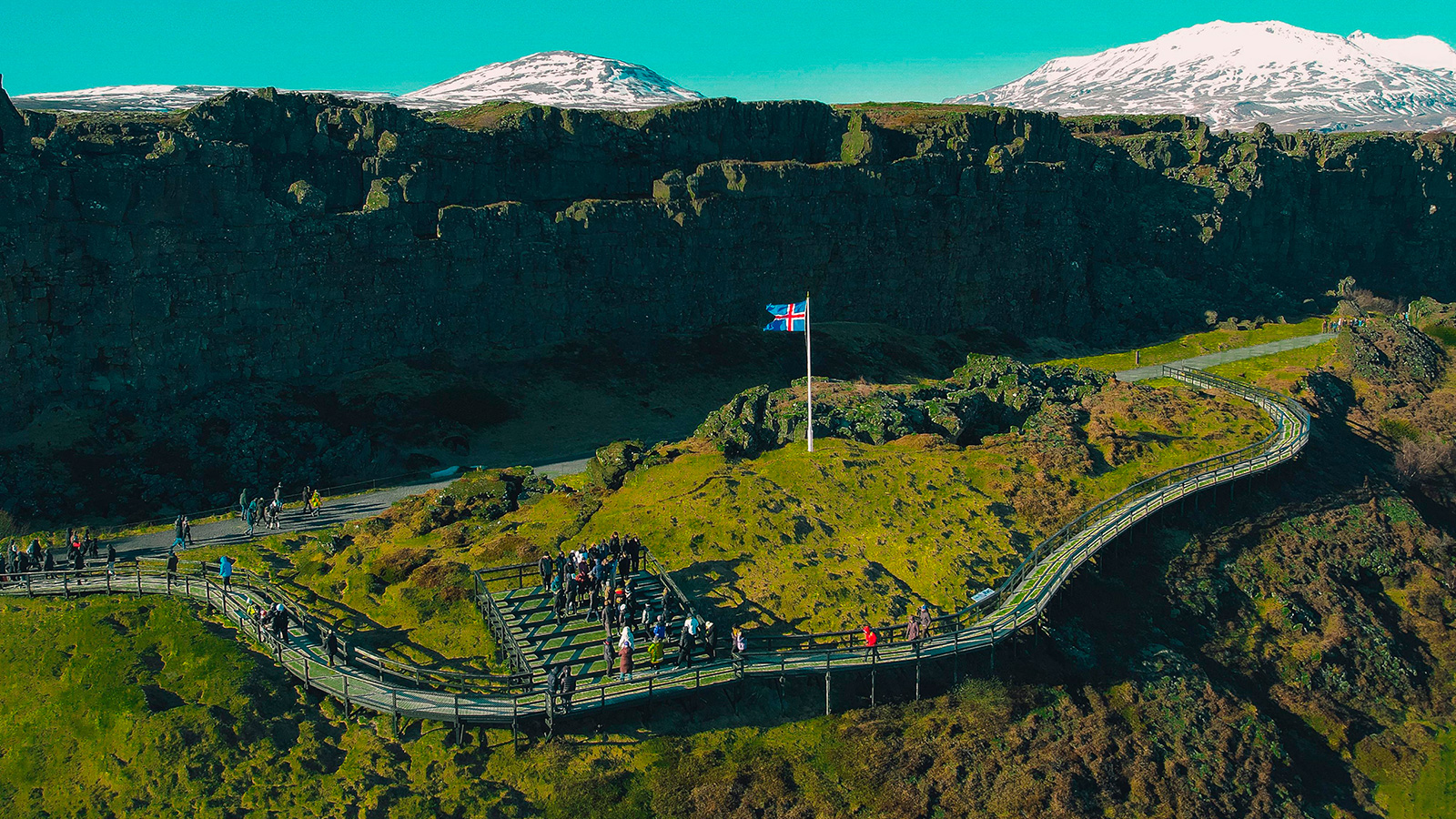
One of the most striking features is Almannagjá Gorge, a dramatic fissure that frames the landscape. Standing here, surrounded by towering walls of volcanic rock, you feel both tiny and deeply connected to the planet’s living forces.
Þingvellir, The Birthplace of a Nation
Long before it became a protected national park, Thingvellir was the stage for something extraordinary: the creation of one of the world’s oldest parliaments.
In the year 930 AD, Icelandic chieftains gathered here to form the Alþingi, establishing laws and resolving disputes in an open-air assembly that continued for centuries.
At Lögberg, or “Law Rock”, laws were spoken aloud for all to hear, a symbol of justice and equality that still defines Icelandic society today.
Walking through Þingvellir, you’re not just visiting a natural wonder; you’re stepping into the birthplace of democracy in Iceland.
The Drowning Pool: A Darker Chapter in Þingvellir’s History
Hidden among Þingvellir’s peaceful landscapes lies a haunting reminder of Iceland’s past: Drekkingarhylur, or The Drowning Pool.
In the 17th and 18th centuries, this calm section of the Öxará river was used to execute women convicted of serious crimes, while men faced hanging or beheading.
Today, the spot is serene and beautiful; its dark history softened by time and nature. Visiting Drekkingarhylur offers a moment of quiet reflection amid Þingvellir’s grandeur, a reminder that Iceland’s most beautiful places often hold the most powerful stories.
Nature in Motion
Þingvellir is a landscape of contrasts: black lava fields softened by green moss, silver rivers cutting through golden plains, and sky-blue waters that seem almost unreal.
The park is also home to Silfra, a narrow fissure filled with crystal-clear glacial water where divers and snorkelers can literally float between two continents.
The water’s clarity, reaching depths of up to 100 metres, creates an otherworldly sensation that makes Silfra one of the world’s most remarkable dive sites.
Each season paints Þingvellir in a new light:
- In summer, the midnight sun casts a golden glow over the fields. Additionally, the advantages of visiting Þingvellir in summer are the pleasant weather, long days with the midnight sun, hiking and diving/snorkeling opportunities, and increased driving safety.
- In autumn, the valley turns into a tapestry of red and orange. Remember that if you visit Þingvellir in the fall, you will enjoy fewer crowds… and the opportunity to witness sheep herding.
- In winter, snow and ice transform it into a silent, shimmering wonderland. There’s no need to say anything else about Iceland in winter, it’s simply a sight worth seeing at least once in your life.
A Sanctuary of Biodiversity
Thingvellir’s diverse habitats support a rich array of flora and fauna. In fact, the park is home to around 40% of Iceland’s plant species, with birch woodlands interspersed with willow and heath.
Lake Þingvallavatn, Iceland’s largest natural lake, harbours three of the country’s five freshwater fish species: brown trout, Arctic char, and the three-spined stickleback.
Bird enthusiasts can also spot various duck species, golden plovers, and common snipes throughout the park.
Other species of Icelandic wildlife can also be found in the park, such as the Icelandic horse (often seen in this area) or the arctic fox, Iceland’s only native land mammal, which can sometimes be seen here.
This delicate balance between volcanic terrain and vibrant life makes Þingvellir not only a geological wonder, but also a living ecosystem.
Stories Beneath the Surface: The Hidden History of Þingvellir
Among Þingvellir’s many wonders lie two captivating places that reveal the park’s more human side: one rooted in legend and good fortune, the other in Iceland’s darker past.
Peningjagjá: The Money Rift
This water-filled crevice has become a place of good luck, a spot where visitors toss coins and make wishes. The tradition dates back to 1907, when the Danish king threw a coin into the rift during his visit to Iceland.
Since then, Icelanders and travellers alike have continued the ritual. While throwing coins into other fissures or rivers is prohibited, Peningjagjá remains the one place where wishes are welcome.
And in true Icelandic humour, on one April Fool’s Day, the national park authorities announced they would begin charging for each coin thrown into the Money Rift (300 ISK for every 100 ISK deposited, with a 15% family discount and a special offer until 6 PM).
The announcement, of course, was retracted the following day but it remains one of the park’s most beloved stories.
Drekkingarhylur: The Drowning Pool
Not far from the gentle flow of wishes lies Drekkingarhylur, or The Drowning Pool, a quiet reminder of a time when justice was harsh and public. In the 17th and 18th centuries, women accused of serious crimes such as infanticide or adultery met their fate here in the cold waters of the Öxará river, while men were hanged or beheaded.
Today, this once-somber place has transformed into a peaceful, reflective spot, surrounded by moss and birdsong. Many visitors pass it unaware of the stories the water could tell. Yet, for those who pause, Drekkingarhylur offers a moment to reflect on Iceland’s past and how far it has come, proof that even in the most beautiful landscapes, history runs deep.
Þingvellir with EastWest
So, embark on an unforgettable journey through the wonders of nature and history at Þingvellir.
With EastWest, you’ll experience the breathtaking beauty and rich cultural heritage of Þingvellir National Park as part of our Golden Circle small-group tour from Reykjavik.
Our knowledgeable local guides will lead you through this iconic destination, unravelling its unique geology, biodiversity, and captivating history. All at a relaxed pace that lets you truly take it in.
Conclusion: Standing Between Earth and History
Visiting Þingvellir is not just about seeing a famous site, it’s about feeling something ancient and powerful.
Here, where two continents drift apart and a nation came together, the air carries both the echoes of history and the whispers of the Earth itself.
No matter what brings you here (the scenery, the stories, or the sense of standing between worlds), Þingvellir captures the very spirit of Iceland.
This place will remind you why Iceland is truly unlike anywhere else on Earth.